Sunday, May 26, 2013
No posts for 3 days

Monday, May 20, 2013
From Russia with Love-The Suprising Paleontology of the Russian Federation
 So, were to begin? The freezing permafrost of Siberia seems a good place to start. Most people who have an interest in the Ice Age and prehistory in general will have heard of the bounty of fossils the Siberian Tundra produces. Mammoth fossils in particular seem to attract most of the attention. Not surprising considering just how beautifully preserved the Mammoth fossils from Siberia are. But the truth is that really, they aren't fossils at all. The Mammoths lived here so recently (new theories suggest that they died out here 8,000-6,000 years ago)that their bones simply haven't fossilized yet. This process is aided by permafrost. Permafrost basically acts as a Pleistocene morgue, keeping the remains of Ice Age animals preserved in the frozen ground only a few inches down. This keeps the bones (and occasionally soft tissue) preserved for prosperity in mint condition. An example of just how crazy this preservation can be is Lyuba a mummified baby mammoth which now resides in the vaults of the Field Museum.
 Lyuba died over 10,000 years ago but every detail of her from her last meal to her hair is exquisitely preserved. It was purportedly in the possession of a Siberian indigenous tribe for many years before scientists finally found it. The tribal members couldn't thank the scientists enough for taking Lyuba. Stating that the dead mammoths possess 'evil spirits'.
But its not only Mammoths found in Siberia. The remains of Horses, Reindeer, and Bison also frequently turn up. The Palaeontology of Siberia has been thrown into the limelight recently with the announcement of 'Pleistocene Park' a project spear headed by numerous Russian Palaeontologists and funded by the Japanese scientists attempting to clone the mammoth back from the dead. All questions of ethics aside the park is actually home to many animals. Mainly Caribou, Horses, and Bison but also including Wolves, Bears, Lynx, and the owner soon hopes Lions and Mammoths.
Lyuba died over 10,000 years ago but every detail of her from her last meal to her hair is exquisitely preserved. It was purportedly in the possession of a Siberian indigenous tribe for many years before scientists finally found it. The tribal members couldn't thank the scientists enough for taking Lyuba. Stating that the dead mammoths possess 'evil spirits'.
But its not only Mammoths found in Siberia. The remains of Horses, Reindeer, and Bison also frequently turn up. The Palaeontology of Siberia has been thrown into the limelight recently with the announcement of 'Pleistocene Park' a project spear headed by numerous Russian Palaeontologists and funded by the Japanese scientists attempting to clone the mammoth back from the dead. All questions of ethics aside the park is actually home to many animals. Mainly Caribou, Horses, and Bison but also including Wolves, Bears, Lynx, and the owner soon hopes Lions and Mammoths.
 Skipping across the Urals we soon reach the banks of the river Volga. The Volga is steeped in history most notably for the ferrying of Soviet troops to defend Stalingrad. But what of the prehistory of the Volga. Surprisingly many species of Ammonite can be found in the rocks here. The Ammonites date from the Upper Jurassic to Lower Cretaceous periods. The most common Ammonites can be found below (in order of appearance: Kosmoceras, Pavlovia, Australiceras, Peltoceras, and Audlioceras)



 As you can see the quality of these Volga ammonites is amazing especially the Peltoceras. No wonder many can fetch for up to 500 rubles on the Russian fossil market. These ammonites are found mostly in the oil sands on the banks of the Volga.
Finally we take a short (in Russian standards) trip north to the rocks around St Petersburg. These rocks just like the Volga Ammonites yield some truly beautiful fossils. Trilobites. The Trilobites here are top quality and date from the Silurian/Ordovician periods.
As you can see the quality of these Volga ammonites is amazing especially the Peltoceras. No wonder many can fetch for up to 500 rubles on the Russian fossil market. These ammonites are found mostly in the oil sands on the banks of the Volga.
Finally we take a short (in Russian standards) trip north to the rocks around St Petersburg. These rocks just like the Volga Ammonites yield some truly beautiful fossils. Trilobites. The Trilobites here are top quality and date from the Silurian/Ordovician periods.
 There are literally so many species that it would take eons (ok, maybe not that long) to list them. But I encourage you to look for yourself here:
So, that's the rather surprising and amazing Palaeontology of the Russian federation. If anyone wants to do any further research or for more information on the Trilobites and Ammonites please visit: Paleoart.com
There are literally so many species that it would take eons (ok, maybe not that long) to list them. But I encourage you to look for yourself here:
So, that's the rather surprising and amazing Palaeontology of the Russian federation. If anyone wants to do any further research or for more information on the Trilobites and Ammonites please visit: Paleoart.com
Saturday, May 11, 2013
Bone headed-Acrotholus audeti
 Around the size of a dog and weighing in at 40Kg Acrotholus is a rather small Pachycephalosaur. And it's size also sets it apart from the rest. "We can predict that many new small dinosaur species like Acrotholus are waiting to be discovered by researchers willing to sort through the many small bones that they pick up in the field," said co-researcher Dr Michael Ryan, curator of vertebrate palaeontology at the Cleveland Museum of Natural History. It has long been suggested that there is not a truthful reflection of small Dinosaur fauna's in existence as their tiny bones may have been to small to properly fossilize. However Acrotholus shows that when it comes to Dinosaurs. The small are just as important as the big.
Wednesday, May 1, 2013
Doggerland-Pleistocene Safari
 Above: Bison Vertebrae from my collection. The Horses would have been different as well. They would have resembled Siberian wild horses with sticking up short manes and stocky bodies.
Another famous resident is the Irish Elk or Megaloceros. This behemoth of a deer stood 6ft 6'' at the shoulder and had antlers that stretched 12ft from tip to tip. Megaloceros would have been a formidable opponent to any Human or Animal hunter alike. It's antlers could certainly pack a punch.
Above: Bison Vertebrae from my collection. The Horses would have been different as well. They would have resembled Siberian wild horses with sticking up short manes and stocky bodies.
Another famous resident is the Irish Elk or Megaloceros. This behemoth of a deer stood 6ft 6'' at the shoulder and had antlers that stretched 12ft from tip to tip. Megaloceros would have been a formidable opponent to any Human or Animal hunter alike. It's antlers could certainly pack a punch.
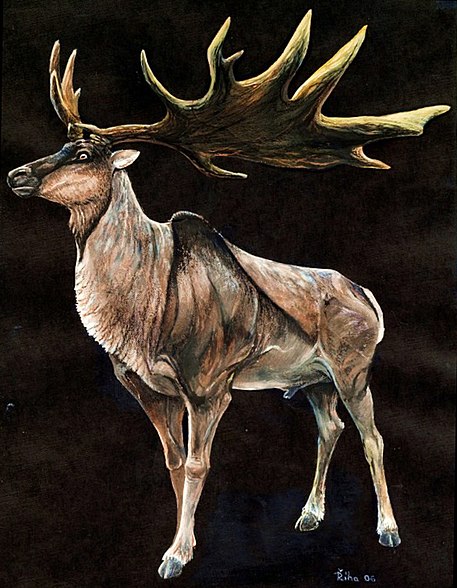 Megaloceros would have engaged in mating displays and fights using it's antler in exactly the same way as modern deer.
But why is this land full of enormous herds of herbivores and rich in resources no longer with us? One word. Tsunami. During the Mesolithic around 8,000 years ago Doggerland was very different to it's Pleistocene heyday. It was forested much like the rest of Europe and was home to Deer, Bear, Wolves, and the bad tempered beef that is the Aurochs. People were beginning to set up permanent homes in the forests looking to exploit the benefits of forest life. But nature had a different idea. Sea level rise caused by the melting ice was already flooding the low lying coast of Doggerland, diminishing the land. Then suddenly 8,000/7,000 years ago an earthquake in the Norwegian sea released a Tsunami right on Doggerland's front door. The Tsunami ravaged Doggerland. Sending much of it to the dark abyss. Some of Doggerland did remain exposed. But as sea levels rose more and more the last remnants of Doggerland a world once teeming with life succumbed to the waves.
Megaloceros would have engaged in mating displays and fights using it's antler in exactly the same way as modern deer.
But why is this land full of enormous herds of herbivores and rich in resources no longer with us? One word. Tsunami. During the Mesolithic around 8,000 years ago Doggerland was very different to it's Pleistocene heyday. It was forested much like the rest of Europe and was home to Deer, Bear, Wolves, and the bad tempered beef that is the Aurochs. People were beginning to set up permanent homes in the forests looking to exploit the benefits of forest life. But nature had a different idea. Sea level rise caused by the melting ice was already flooding the low lying coast of Doggerland, diminishing the land. Then suddenly 8,000/7,000 years ago an earthquake in the Norwegian sea released a Tsunami right on Doggerland's front door. The Tsunami ravaged Doggerland. Sending much of it to the dark abyss. Some of Doggerland did remain exposed. But as sea levels rose more and more the last remnants of Doggerland a world once teeming with life succumbed to the waves.

Friday, April 19, 2013
Dahalokely tokana-A Meat eating Madagascan Dinosaur.
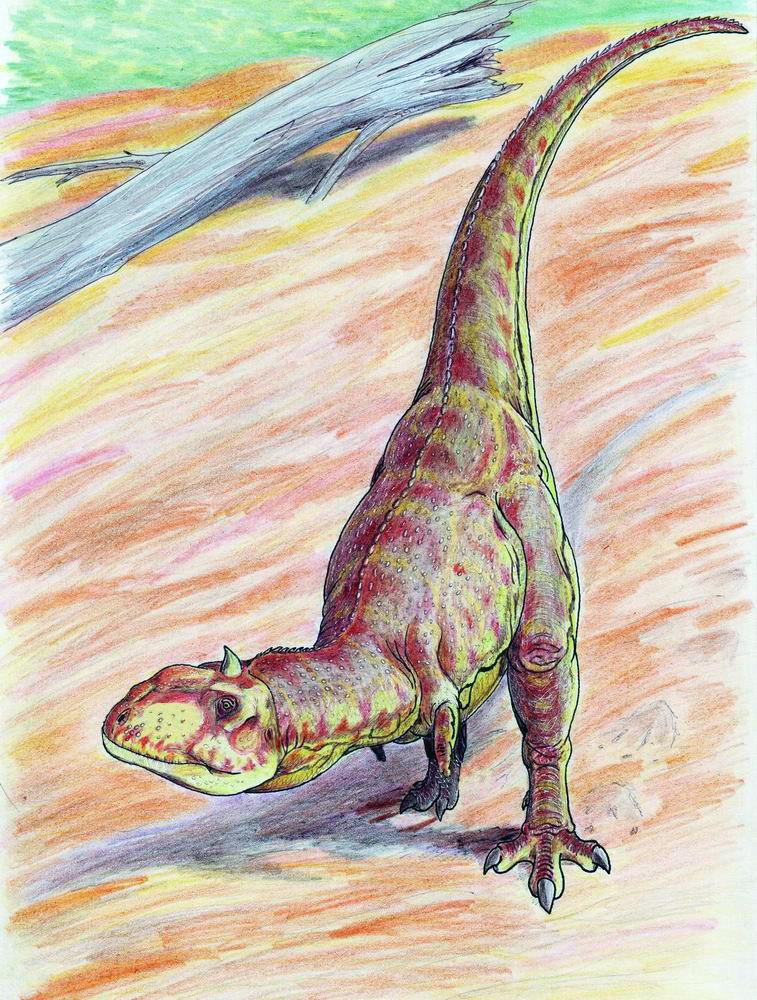 Abelisaurs were common in the southern hemisphere at this time and were ferocious predators. Joe Sertich says 'It just reinforces the importance of searching previously unsearched areas for new Dinosaurs waiting to be discovered'.
Friday, April 12, 2013
Australopithecus Sediba-The Most in Depth Analysis Yet
 The findings, focusing mainly on the species locomotion infer an unusual style of walking. Dr DeSilva has found that The heel bones represent that of a Chimpanzee more than Human. Suggesting it walked with an inward twist of the knee and hip with it's feet facing inward. However not all of their time was spent on the ground. They appear to have numerous adaptions to an arboreal (tree-climbing)lifestyle. Many more adaptions to tree climbing than are found in other Australopithecine species. Additional information gathered from the study suggest that the 3 individuals were related and died as a result of becoming trapped in the collapsed cave complex. Eventually there bodies were washed away into a pool along with Hyena, Saber-tooth cat, and Gazelle remains. This type of fossilisation has led to some experts believing that a layer of filmy substance found associated with the fossils is the skin of the individuals although this is as of yet un-concluded . All findings were reported to the Palaeoanthropological in a special presentation in Honolulu, Hawaii.
In recent years it has become much more apparent that our evolution is not linear as first thought but instead is branched. This means that evolution has not led up to us but instead that we are one of many branches of an extended family. We are constantly reminded that we are the best, not only out of the Hominids or primates but out of all life on earth. The fact is: We simply aren't.
There are many dominant species. For instance we cannot climb a tree as fast as a Gibbon, chase down a Zebra as fast as a lion, swim as well as a Dolphin, or reproduce as fast as Bacteria. We are the best at what we do. Thinking, problem solving, and social skills. These skills have led to our evolutionary supremacy over other species that have those skills. In the same way that Birds are the dominant design over other flying creatures. Which has led to the extinction of many other flying Vertebrates such as Pterosaurs. This is indicative of the way we have brought about the extinction of species how do what we do such as Homo Erectus and Neanderthals. Thus we are not the best but the best out our specific niche.
Native American legends state 'Man and animals used to be very close, then man thought himself better than the animals, so they quit talking to us'. This rings true in how our affinity with the Natural has wained. In many ways this loss could be responsible for our disregard for our planet a problem we are now desperately trying to solve. Therefore it is possible to conclude that our evolutionary arrogance is responsible for the way we have damaged the natural world. The view that nature is 2nd rate to us is wrong. Nature is a force that has proven many times in our past that it has the power to destroy us in seconds. Consequently respect and understanding of the Natural world is imperative and could define the only escape route we have from our never ending spiral of harm we are inflicting upon the planet and it's consequences. After all who knows what curveball nature may throw at us in future.
The findings, focusing mainly on the species locomotion infer an unusual style of walking. Dr DeSilva has found that The heel bones represent that of a Chimpanzee more than Human. Suggesting it walked with an inward twist of the knee and hip with it's feet facing inward. However not all of their time was spent on the ground. They appear to have numerous adaptions to an arboreal (tree-climbing)lifestyle. Many more adaptions to tree climbing than are found in other Australopithecine species. Additional information gathered from the study suggest that the 3 individuals were related and died as a result of becoming trapped in the collapsed cave complex. Eventually there bodies were washed away into a pool along with Hyena, Saber-tooth cat, and Gazelle remains. This type of fossilisation has led to some experts believing that a layer of filmy substance found associated with the fossils is the skin of the individuals although this is as of yet un-concluded . All findings were reported to the Palaeoanthropological in a special presentation in Honolulu, Hawaii.
In recent years it has become much more apparent that our evolution is not linear as first thought but instead is branched. This means that evolution has not led up to us but instead that we are one of many branches of an extended family. We are constantly reminded that we are the best, not only out of the Hominids or primates but out of all life on earth. The fact is: We simply aren't.
There are many dominant species. For instance we cannot climb a tree as fast as a Gibbon, chase down a Zebra as fast as a lion, swim as well as a Dolphin, or reproduce as fast as Bacteria. We are the best at what we do. Thinking, problem solving, and social skills. These skills have led to our evolutionary supremacy over other species that have those skills. In the same way that Birds are the dominant design over other flying creatures. Which has led to the extinction of many other flying Vertebrates such as Pterosaurs. This is indicative of the way we have brought about the extinction of species how do what we do such as Homo Erectus and Neanderthals. Thus we are not the best but the best out our specific niche.
Native American legends state 'Man and animals used to be very close, then man thought himself better than the animals, so they quit talking to us'. This rings true in how our affinity with the Natural has wained. In many ways this loss could be responsible for our disregard for our planet a problem we are now desperately trying to solve. Therefore it is possible to conclude that our evolutionary arrogance is responsible for the way we have damaged the natural world. The view that nature is 2nd rate to us is wrong. Nature is a force that has proven many times in our past that it has the power to destroy us in seconds. Consequently respect and understanding of the Natural world is imperative and could define the only escape route we have from our never ending spiral of harm we are inflicting upon the planet and it's consequences. After all who knows what curveball nature may throw at us in future.
Wednesday, April 10, 2013
Spinosaurus-Flesh Tearing Behemoth or Seafood Connoisseur?
 Spinosaurus aegypticus, a Dinosaur flung into the public spotlight due to it's appearance in JP3. In which it is portrayed as a relentless predator intent on devouring any how get in it's way. But was Spinosaurus really a T-Rex pwning, tourist chasing super predator or a Piscivore.
So how can we ascertain whether Spinosaurus ate Fish or meat? Well, as usual the answer lies in the bones. Firstly the teeth of Spinosaurs in general are very conical, an affinity they share with Crocodilians who although are Piscivorous but are not strangers to a bit of meat. Spinosaurs have often been compared with Crocodiles due to their elongated snouts and teeth. Additionally the nostrils of Spinosaurus are situated atop the head in much the same way as a Crocodile!
Spinosaurus aegypticus, a Dinosaur flung into the public spotlight due to it's appearance in JP3. In which it is portrayed as a relentless predator intent on devouring any how get in it's way. But was Spinosaurus really a T-Rex pwning, tourist chasing super predator or a Piscivore.
So how can we ascertain whether Spinosaurus ate Fish or meat? Well, as usual the answer lies in the bones. Firstly the teeth of Spinosaurs in general are very conical, an affinity they share with Crocodilians who although are Piscivorous but are not strangers to a bit of meat. Spinosaurs have often been compared with Crocodiles due to their elongated snouts and teeth. Additionally the nostrils of Spinosaurus are situated atop the head in much the same way as a Crocodile!
 Further clues may lie in other Spinosaurs most notably Baryonyx. Baryonyx is a Spinosaur from the Early Cretaceous of Europe 130 million years ago. The majority of it's remains have been found in the UK. The first skeleton was discovered by amateur fossil hunter Bill Walker in the 80's. Initially only the huge claw of Baryonyx was found. But Palaeontologists from the NHM later discovered the majority of the skeleton. Typically it had a long snout, high nostrils, and conical teeth. But it was what was found in the stomach location that shocked the Palaeontologists. The scales and bones of the 1m fish Lepitodes. Thus indicating a diet of fish. Baryonyx was evidently a fish eater it's teeth had no serrations were purely conical. But the teeth of Spinosaurs did however have serrations. This suggests Spinosaurus had a generalized diet compromising of both fish and meat (There is evidence of a Spinosaur eating a Pterosaur!).
So for Spinosaurs, It will be a steak with fish fingers on the side!( and a bit of Pterosaur)
Further clues may lie in other Spinosaurs most notably Baryonyx. Baryonyx is a Spinosaur from the Early Cretaceous of Europe 130 million years ago. The majority of it's remains have been found in the UK. The first skeleton was discovered by amateur fossil hunter Bill Walker in the 80's. Initially only the huge claw of Baryonyx was found. But Palaeontologists from the NHM later discovered the majority of the skeleton. Typically it had a long snout, high nostrils, and conical teeth. But it was what was found in the stomach location that shocked the Palaeontologists. The scales and bones of the 1m fish Lepitodes. Thus indicating a diet of fish. Baryonyx was evidently a fish eater it's teeth had no serrations were purely conical. But the teeth of Spinosaurs did however have serrations. This suggests Spinosaurus had a generalized diet compromising of both fish and meat (There is evidence of a Spinosaur eating a Pterosaur!).
So for Spinosaurs, It will be a steak with fish fingers on the side!( and a bit of Pterosaur)
Subscribe to:
Posts (Atom)